The disease is a devastating disease and an important limiting factor in tomato production in many parts of the world, mainly in tropical and subtropical regions. my country's Guangxi, Guangdong, Taiwan and Yunnan have occurred. Affected plants are dwarfed, the top leaves are yellowed and smaller, and the leaf edges curl upwards. In the early stage of growth and development, the infected plants are severely dwarfed, unable to bloom and bear fruit normally; in the late stage, only the upper leaves and new shoots of the infected plants show symptoms, the fruit decreases, the fruit becomes smaller, and basically loses its commercial value.
The causative agent of the disease is Tomato Yellow Leaf Curl Virus (TYLCV), which belongs to the group of geminiviruses that infect whitefly. Bemisia tabaci can transmit virus for life after being infected, but not through eggs; mechanical friction and seeds do not transmit virus; grafting can lead to virus transmission.
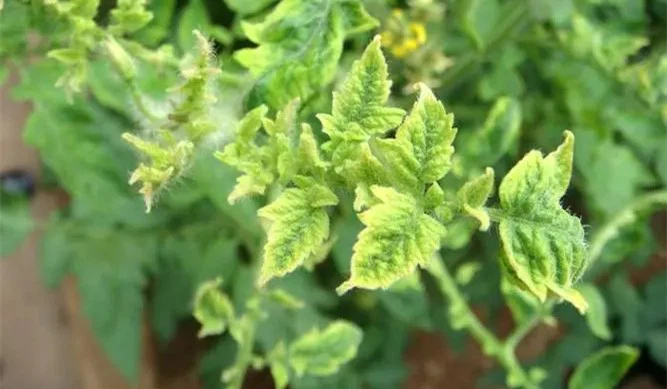
The reasons for the outbreak of the disease include climate reasons. High temperature and dry weather are favorable for the occurrence and reproduction of the insect vector Bemisia tabaci; the occurrence of Bemisia tabaci is common; there are many poisonous plants and poor variety resistance.
Although yellow leaf curl virus disease rarely occurs in rice-vegetable rotation land, it should be paid attention to. Cultivating disease-free and insect-free seedlings is the key to preventing and controlling the disease. Prevention should start from seedling cultivation, early prevention and early control, and emphasis on prevention of whitefly.
Prevention methods:
① Adopt disease-resistant varieties: Feitian, Zheza 301, Linda, Hangza 301, etc.
② Eliminate the intermediate host of the virus: Dilute alkali, chicory, datura, tobacco and papaya are the intermediate hosts of the tomato yellow leaf curl virus. Before planting tomatoes, the surrounding weeds should be removed, and the planting place should be far away from tobacco and papaya. For crops such as papaya, tomatoes should not be planted near diseased plantings to avoid cross-spreading of the virus.
③Prevention of Bemisia tabaci: From sporadic occurrence of Bemisia tabaci, alternately use 1000-1500 times liquid of 25% Pubiling wettable powder, or 2000-3000 times liquid of 25% Actai water dispersible granules, or 2.5% Uranus Spray control with 2000-3000 times of EC, or fumigate with 22% dichlorvos smoke agent 7.5 kg/ha in the protected area.
④ Cover with insect-proof nets or adjust the planting period: Facility cultivation can be carried out if conditions permit, and insect-proof nets should be used to protect and isolate planting. Attention should be paid to setting buffer doors and closing doors carefully when entering and exiting to prevent the poisonous whitefly from spreading the virus. Tomatoes are planted in winter or spring, the temperature is lower, the occurrence of Bemisia tabaci is less, and the activity is not strong, which is not conducive to the occurrence and spread of the disease.
Expert Tip: Yellow leaf curl virus disease is a serious disease in the arid regions of southern China. Although it rarely occurs in rice-vegetable rotation land, attention should be paid to prevent the spread of the disease starting from seedling cultivation.