symptom
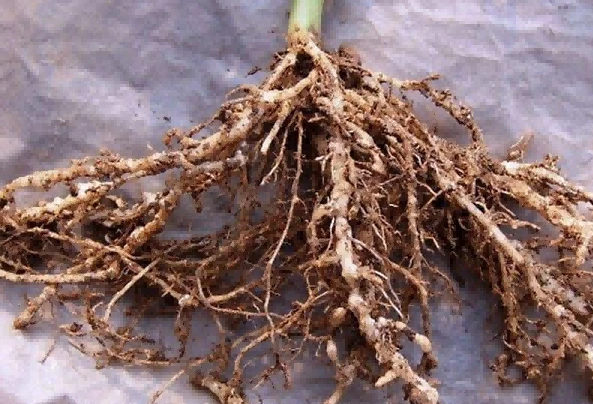
In the early stage of plant growth, the young roots are drilled into the root tissue cells by the 2nd instar larvae of root-knot nematodes, causing tumors to form in the roots, affecting the absorption of water and nutrients. The aboveground part shows yellowing symptoms, and after one month, the second instar larvae develop into adults. When the conditions are suitable, the eggs laid by the adults quickly hatch into larvae and move in the soil. After some eggs buried in the tissue hatch, the larvae grow in the tissue on the spot. Due to the root-knot nematode's stabbing and eating, they drill around and cause many wounds to cause tissue necrosis, poor plant growth or death of the whole plant.
pathogen
Meloidogyne incognita (Kofoid et White) Chitwood, claims root-knot nematode incognita, belongs to the animal kingdom nematodes. The pathogenic nematodes are dioecious, and the larvae are elongated and worm-like. Male adults are linear, slightly rounded at the end, colorless and transparent, with a size of (1.0-1.5) mm×(0.03-0.04) mm. The female adult is pear-shaped, and each female nematode can lay 300-800 eggs, most of which are buried in the host tissue.
Transmission routes and disease conditions
Spinach root-knot nematode overwinters in the soil as 2nd instar larvae and eggs along with diseased residues. After the temperature rises in the next year, the overwintering eggs hatch into larvae, continue to develop and invade the host, and stimulate the proliferation of host root cells to form root knots. After the larvae develop to the 4th instar, they mate and lay eggs. The males leave the root knot and enter the soil and die soon. The eggs left in the root knot hatch to larvae. After entering the 2nd instar, they burrow into the soil again for re-infection or overwintering. The soil temperature is 25-30 ℃, the water holding capacity is 40%, the growth is fast, and the disease is serious in continuous cropping land.

Prevention method
① Cultivate insect-free seedlings.
② Carry out crop rotation and stubble.
③ Before sowing or planting, use the summer greenhouse leisure period to choose a sunny day to plow the soil 30cm deep, sprinkle 50-100kg of calcium cyanamide per 667m2, and then cover 1000kg of 4-5cm long wheat straw, then pour large water and close the shed for 15-20 days for high temperature Stuffy shed, temperature up to 60 ℃ can kill root-knot nematodes.
④ Chemical treatment of the soil, 15 days before sowing, use 10% thiazophosphine granules or 0.5% avermectin granules 2kg per 667m2, add 40kg of fine soil, mix well, sprinkle on the ground, plow 25cm deep, and the control effect can be achieved. In an emergency, 0.8% abamectin microcapsule suspension 0.96g/667m2 can also be used to irrigate the roots at the early stage of the disease. The validity period is about 14 days.