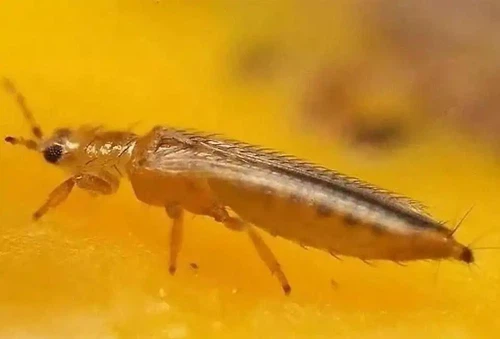
Thrips belong to the order Thysanoptera. They are small in size but very harmful. They hide during the day and come out at night. Their rasp-sucking mouthparts harm plants, causing plant nutrient loss and destroying their commercial value. At the same time, they spread viruses and harm plant health. This brings unknown economic losses to the majority of growers.
In recent years, with the ban and restriction of the use of highly toxic pesticides, there are currently few single agents on the market that can completely solve the harm of thrips. Generally, two or more types of agents are used to form a combination plan, or more efficient tank-mixed adjuvants are used to control thrips to reduce the economic losses caused by thrips.
Today, I will introduce some means and methods that can effectively control thrips.
Life habits of thrips
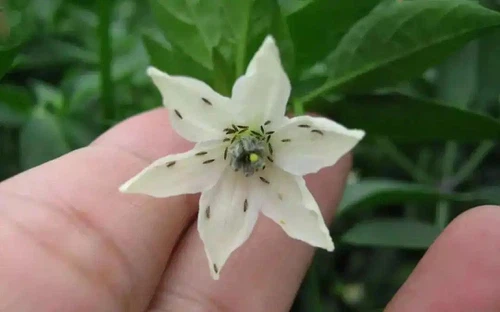
Thrips mainly harm crops such as eggplant, cucumber, kidney bean, pepper, and watermelon. Female adults mainly reproduce parthenogenetically, occasionally bisexually, and male insects are extremely rare. Eggs are scattered in the mesophyll tissue, and each female lays 22-35 eggs. Female adults have a lifespan of 8-10 days. Nymphs stop feeding on the back of leaves at the end of their old age and fall into the surface soil to pupate.
Thrips like warm and dry weather, with an optimum temperature of 23℃-28℃ and an optimum air humidity of 40%-70%. They cannot survive in excessive humidity. When the humidity reaches 100% and the temperature reaches 31℃, all nymphs die. In the rainy season, if there is continuous overcast and heavy rain, water will accumulate in the axils of onion leaves, which can cause the death of nymphs. After heavy rain or watering, the soil becomes compacted, making it impossible for nymphs to enter the soil to pupate and pupae to hatch into adults.
Damage caused by thrips
Thrips use adults and nymphs to suck the juice of young and tender tissues (twigs, leaves, flowers, fruits, etc.) of plants. The affected young leaves and tender shoots become hard, curled and withered, the plants grow slowly, and the internodes are shortened. Young and tender fruits (such as eggplant, cucumber, watermelon, etc.) will harden after being damaged, and in severe cases, they will fall, seriously affecting the yield and quality.
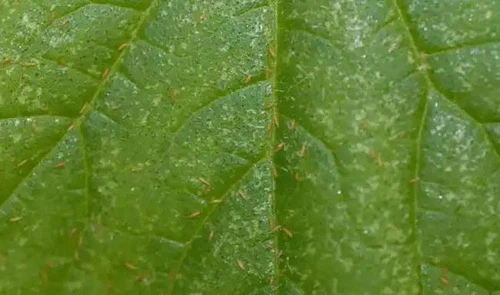
After the young leaves are damaged, the leaves become thinner, gray-white or gray-brown stripes appear on both sides of the midrib of the leaves, the epidermis is gray-brown, deformed, curled, and weak in growth, which is easily confused with the damage caused by the side polyphagous tarsoneme.
After the young fruit is damaged, the epidermal oil cells rupture, gradually lose water and shrink, and the scars expand as the fruit expands, showing different shapes of corky silver-white or gray-white scars. But a small number of them occur in the waist and other parts of the fruit. This type of "scar fruit" can be roughly divided into three categories: one is a ring-shaped scar about 0.5cm away from the fruit pedicle, with a width of 2-3mm; the second is one or more irregular linear or tree-shaped scars about 1mm wide on the fruit surface; the third is one or more irregular circular scars the size of a button on the fruit surface or navel. Circular scars are often accompanied by tree-shaped scars. In the young fruit stage, the scar is silvery white and feels rough when touched by hand; on mature fruits, it is dark red or dark red, smooth and shiny.
Prevention and control methods
Agricultural prevention and control: remove weeds and dead branches and leaves in the field in early spring, burn or bury them in a centralized manner, and eliminate overwintering adults and nymphs. Strengthen fertilizer and water management to promote plant growth and reduce damage.
Physical control: Take advantage of the habit of thrips to turn blue, set up blue sticky boards in the field to lure and kill adults, and the height of the sticky boards should be the same as that of the crops.
Chemical control: Conventional pesticides such as imidacloprid and acetamiprid are routinely used, and the prevention effect gradually decreases.
At present, the following prevention and control methods are being promoted internationally:
Thrips and planthoppers in the rice seedling stage: It is recommended to use thiamethoxam varieties, 30% thiamethoxam suspension seed dressing, and 70% imidacloprid wettable seed dressing.
Vegetables: Solanum, melons, and beans use 25% thiamethoxam water-dispersible granules 3,000-5,000 times for root irrigation to reduce the release of viral diseases and reduce the damage of underground pests.
Fruit trees: For crops that are seriously damaged by thrips, such as mangoes, 25% thiamethoxam can be sprayed, but the dosage should be increased, such as 800 times spray, and high-content avermectin benzoate and bifenthrin can be mixed.
Tobacco: Root irrigation before transplanting or root spraying during planting, imidacloprid and clothianidin can be used; 25% imidacloprid 1,000 times, 25% thiamethoxam 3,000-5,000 times.
Highly resistant thrips, such as thrips on beans, eggplants, peppers and other crops in Guangxi and Shouguang, are of various types and have strong resistance. Conventional thiamethoxam, imidacloprid and other ingredients are difficult to achieve control effects. Alux + cypermethrin + tolfenpyrad, a compound product, has a better control effect.
Precautions for prevention and control
According to the characteristics of thrips that are dormant during the day and come out at night, it is recommended to use the medicine in the afternoon.
Thrips are highly concealed, and the pesticide needs to be systemic or add silicone adjuvants, and try to choose a pesticide with a long lasting effect.
If conditions permit, it is recommended to combine root irrigation with foliar spraying.
Take precautions in advance, and do not wait until the flooding occurs before using the medicine. When planting vegetables during high temperatures, if there is no mulch, it is best to spray the middle and lower parts of the plants and the ground at the same time, because these places are the habitats of thrips nymphs.