(1) Instructions
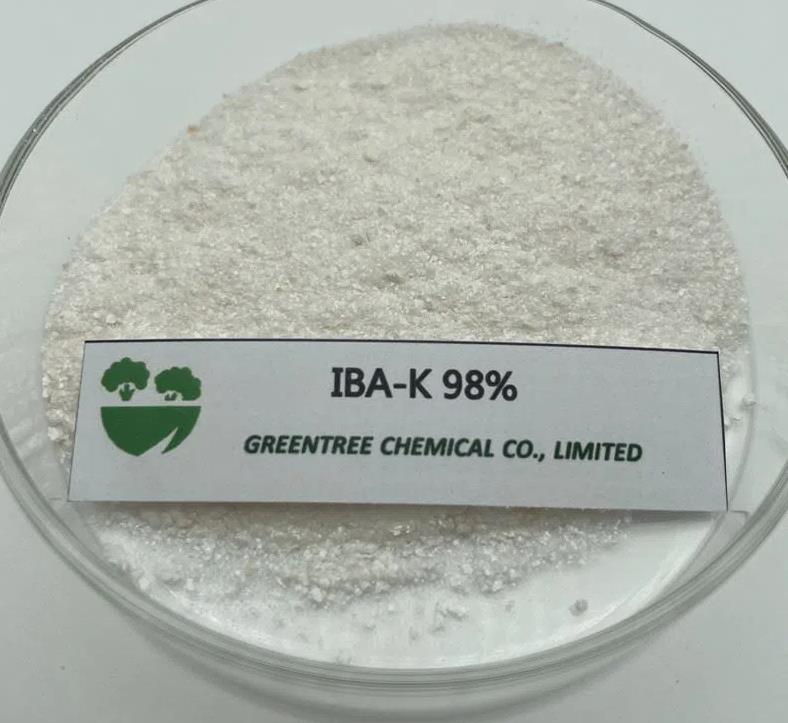
Potassium indole butyrate(IBA-K) can promote fruit setting or parthenogenesis of tomatoes, peppers, cucumbers, figs, strawberries, black fungus, eggplants, etc. The concentration of dipping or spraying flowers and fruits is about 250 mg/L. Due to the high cost of single-agent use, it is currently mostly used for compounding.
The main purpose is to promote the rooting of various plant cuttings and the early rooting and multiple rooting of some transplanted crops.
(2) Common usage and usage
①Dipping method (also known as soaking method): Use a lower concentration for the species that are easy to take root, and use a slightly higher concentration for the species that are not easy to take root. Generally, 50-200mg/L is used to impregnate the base of the cuttings, and the time is about 8-24 hours. High concentration and short soaking time.
②Quick soaking method: Potassium indole butyrate(IBA-K) is 500-1000mg/L, and the base of the cuttings is soaked for 5-7 seconds.
③Dipping powder method: powder use: put an appropriate amount of Potassium indole butyrate(IBA-K), containing 1000-5000 mg/L of the active ingredient of growth regulator, and then soak talcum powder or clay in alcohol, and the alcohol volatilizes to obtain powder. The dosage is: 0.1~0.3%. Wet the base of the cuttings first, then dip or spray with powder. Before dipping the cuttings in the powder, soak the base with water, and shake off the excess powder after dipping.
1. Grapes
Take out the grape branches stored in the sand and cut them into double-bud cuttings with a length of 7 to 9 cm. Leave 1.0 to 1.5 cm at the top of the buds, and cut the bottom 0.5 to 1.0 cm away from the node. L of potassium indolebutyrate solution for 14 hours, or soak the branches at 20-50 mg/L for 24 hours; then cuttings. Immediately after plugging, water well and cover with film.
After watering every 3 to 4 times, the survival rate of cuttings is higher and the quality of seedlings is better. More than 200mg/L will cause certain damage to the cuttings tissue, but it is not conducive to the germination and rooting of cuttings and seedlings.
The method of dipping is commonly used to promote the rooting of grapes, and it can be divided into the following three types due to the length of dipping and the different dosage forms.
Quick dip: take an appropriate amount of Potassium indole butyrate(IBA-K) (or IBA mixed with an appropriate amount of ethanol to dissolve), dilute it with water to the required concentration (usually 500-2000mg/L), and place the bundled cuttings in the medicinal solution medium, soak for 5-10 seconds, take out to dry, and cut.
Slow dip: make Potassium indole butyrate(IBA-K) (or an appropriate amount of IBA mixed with a small amount of ethanol to dissolve) into a liquid with a concentration of 20-50mg/L, then immerse the cuttings in the liquid for 8-24 hours, and take out the cuttings.
Dipping powder: Dissolve an appropriate amount of Potassium indole butyrate(IBA-K) (or IBA mixed with an appropriate amount of ethanol), add talc and other auxiliary agents, and after the ethanol is volatilized, it becomes a powder, and then soak the base of the cuttings, dip in the powder, and cut.
2. Apple, Pear, Peach
Before grafting, dipping the scion in 200-400mg/L Potassium indole butyrate(IBA-K) solution and grafting can improve the survival rate, but it has an inhibitory effect on the growth of buds, and the higher the concentration, the greater the inhibitory effect. , can promote its thickening growth. Soak branches at 1000 mg/L for 5 seconds;
3. Chinese rose, pomegranate
Low concentration immersion method. Select the 1-2 year old branches with full development, full bud eyes, and no pests and diseases, cut them into 60-80cm long, and after sand storage in a bundle of 50, cut them into a horse ear shape at the upper end 1.5 cm away from the bud eyes, cuttings 15--20 cm long, with the inclined surface rubbed straight down, generally use Potassium indole butyrate(IBA-K) solution at a concentration of 50 to 200 mg/L. The soaking time is 8 to 12 hours. The higher the concentration, the shorter the soaking time.
Cuttings after soaking can speed up the rooting speed of cuttings, increase the number of root systems, improve the survival rate, accelerate the growth rate of new shoots, and the seedlings grow well.
4. Yew
One-year-old and two-year-old all lignified branches of Taxus chinensis are used as cuttings, the cuttings are 10-15 cm long, have a terminal bud or short lateral bud, the upper incision is flat, the lower incision is oblique, and the indole at 50¬¬-80mg/L Soaking in potassium butyrate solution for 12 hours has obvious effect on improving the rooting rate of cuttings and promoting root system development.
5. Gypsophila, Rhododendron, Fuchsia, Rose, Chrysanthemum
Dip with 100mg/L Potassium indole butyrate(IBA-K) solution for 3 hours, or dip in 2000mg/L (mg/L) Potassium indole butyrate(IBA-K) solution for 20 seconds, it can promote the rooting of cuttings, gypsophila, rhododendron and chrysanthemum. Effect.
Treating Fuchsia with 500-1000mg/L Potassium indole butyrate(IBA-K) solution has obvious effect on promoting rooting. Soaking rose cuttings with 15-25mg/L potassium indolebutyrate solution and chrysanthemum cuttings with 25mg/L solution can promote rooting.
6, osmanthus cutting skills
Soak the lower end of the cuttings with 200 mg/L to 500 mg/L Potassium indole butyrate(IBA-K) (or indole butyric acid and its potassium salt) for 5 to 10 minutes. Water well after inserting, then cover with plastic wrap.
7. Cutting technology of jujube twigs to promote root treatment
The ideal method in practice is to treat with naphthalene acetic acid and indole butyric acid. That is, 1 g of naphthalene acetic acid is added to 10 to 20 kg of water, and 0.1 g of indole butyric acid is added to 1 to 2 kg of water. The naphthaleneacetic acid solution was then mixed with the indolebutyric acid solution in a ratio of 9:1. When applying, pour the mixture into a plastic pot, and soak it for 12 hours with the water surface exceeding the twigs by 3 to 5 cm deep.
8. Cypress
Soak branches at 100-200 mg/L for 6-24 hours;
9. Tea
Soak the branches at 20-40 mg/L (the lower end of the cuttings is 3-4 cm, the same below) for 5-8 hours; for promoting the hairy roots of tea tree cuttings, use an equal mixture of 15ppm indole butyric acid and 15ppma-naphthalene acetic acid Soak for 8-16 hours for best results.
10. Mulberry
Soak new branches at 5 mg/L for 24 hours or 1000 mg/L for 3 seconds, hard branches at 100 mg/L for 24 hours or 2000 mg/L for 3 seconds;
11. Cedar, Japanese cypress
Soak at 100 mg/L for 24 hours;
12. Pine
Soak 1-year-old branchlets at 50 mg/L for 16 hours; Arborvitae: soak vigorously growing branches at 25-100 mg/L for 12 hours from April to June;
13. Rhododendron, boxwood
Soak branches at 100 mg/L for 3 hours;
14. Pepper
Soak branches at 25-50 mg/L for 12-24 hours;
15. Citrus
Treat the air batter with an aqueous solution containing 1000 mg/L;
16. Chinese kiwi
Soak branches at 200 mg/L for 3 hours. All of the above can promote the rooting of cuttings and improve the survival rate of cuttings. 17. Sprinkle the soil with 10-80 mg/L of rice, ginseng, saplings, etc., which can promote early rooting and developed root system after transplanting.
Reminder: Before using, please be sure to experiment on a small area. Due to different factors such as the environment, it may cause crop damage. Please follow the professional guidance and use it strictly.