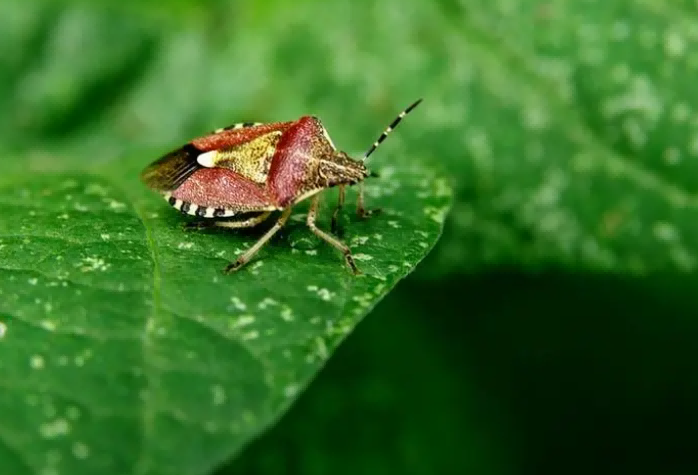
Nipheelon-gata(Dallas), its adults and nymphs mainly pierce and suck the juice of tender ears after rice heading, causing rice grains or crappy grains, and can also damage leaves and stems, as well as wheat, corn, beans, etc. The editor will introduce to you the control methods of rice brown stink bug.
1. Living habits
Adults and nymphs mainly suck the juice of the tender ears of rice, causing shriveled grains, shriveled grains, white ears, and also damage to stems and leaves. Adults spend the winter in shrubs, weeds, fallen leaves or graveyards, hillsides, etc. near the rice fields, and move into the rice fields in June.
Adults have suspended animation and phototaxis. Eggs are often arranged in single or double rows on the back of rice leaves, and a few are produced on leaf sheaths, stems and ears. The nymphs are generally five instars, the first instar nymphs lie still next to the original egg shell and do not feed, and the second instar nymphs begin to disperse and feed harm.
On cloudy days, it can harm the rice plants all day long. On sunny days, the damage is more common before 10 am and after 4 pm. Near noon and when the wind and rain are heavy, it is mostly lying on the base of the rice stem or the back of the rice leaves.
2. Prevention and control methods
(1) 25% Pymetrozine WP (low toxicity) Use 20-32 g/mu spray (therapeutic)
Apply during the pest infestation period. When spraying, be even and thoughtful, especially on the affected areas of the target pests. The safety interval is 14 days and can be used up to 2 times per season.
(2) 1.8% Avi acetamiprid microemulsion (low toxicity) Use 30-60ml/mu spray
During the control period, the 1-2 instar larvae have the best effect. The safety interval is 2 days and the maximum number of applications per crop cycle is 3.
(3) 200 g/L Imidacloprid solution (low toxicity) Use 5000-8000 times liquid spray (therapeutic)
During the juvenile and nymph stages of the pests. The seedling aphid is controlled by the drip irrigation system. In the early stage of aphids, the drip irrigation is applied, and the water consumption per mu is 20 cubic meters. Do not apply on windy days or when rainfall is expected within 1 hour.