Hey there! As a kinetin supplier, I often get asked about how kinetin is synthesized in the lab. So, I thought I'd take a moment to break it down for you.
First off, let's talk a bit about what kinetin is. Kinetin is a type of cytokinin, which is a plant growth regulator. It plays a crucial role in promoting cell division, delaying senescence, and enhancing the growth and development of plants. That's why it's so popular in the agricultural industry.

Now, onto the synthesis part. There are a few different methods to synthesize kinetin in the laboratory, but the most common one involves the reaction of 6 - aminopurine (adenine) with furfural.
Step 1: Preparation of Reactants
We start by getting the two main reactants ready. Adenine is a well - known purine base, and it can be easily obtained commercially. It's a white, crystalline powder that's relatively stable under normal conditions. Furfural, on the other hand, is an aldehyde derived from agricultural by - products like corncobs and oat hulls. It has a distinct smell and is a clear, yellowish liquid.
Step 2: The Reaction
The reaction between adenine and furfural usually takes place in an alkaline medium. We mix adenine and furfural in a suitable solvent, often an aqueous solution with a base like sodium hydroxide. The base helps to deprotonate the adenine, making it more reactive.
The reaction is a condensation reaction. The amino group of adenine reacts with the carbonyl group of furfural. The reaction conditions are carefully controlled, including temperature and reaction time. Usually, the reaction is carried out at a moderate temperature, around 50 - 70 degrees Celsius, for a few hours. This allows the reaction to proceed smoothly without causing any unwanted side reactions.
Step 3: Isolation and Purification
Once the reaction is complete, we need to isolate and purify the kinetin. First, we use a separation technique, such as extraction. We add an organic solvent to the reaction mixture, and the kinetin will dissolve in the organic layer. We then separate the organic layer from the aqueous layer.
After extraction, we use purification methods like recrystallization. We dissolve the crude kinetin in a suitable solvent at a high temperature and then slowly cool the solution. As the solution cools, the kinetin will crystallize out, leaving the impurities in the solution.
There are also some variations of this synthesis method. For example, some researchers use different starting materials or modify the reaction conditions to improve the yield or purity of kinetin.
Now, if you're in the market for plant growth regulators, we've got a great range of products. Check out Forchlorfenuron KT - 30 Cppu Organic Fertilizer 99% Promote Plant Growth. It's an amazing product that can really boost plant growth.
We also offer CAS NO. 6025 - 53 - 2 Trans - Zeatin - Riboside 99% Cytokinins. This is another type of cytokinin that has unique properties for plant development.
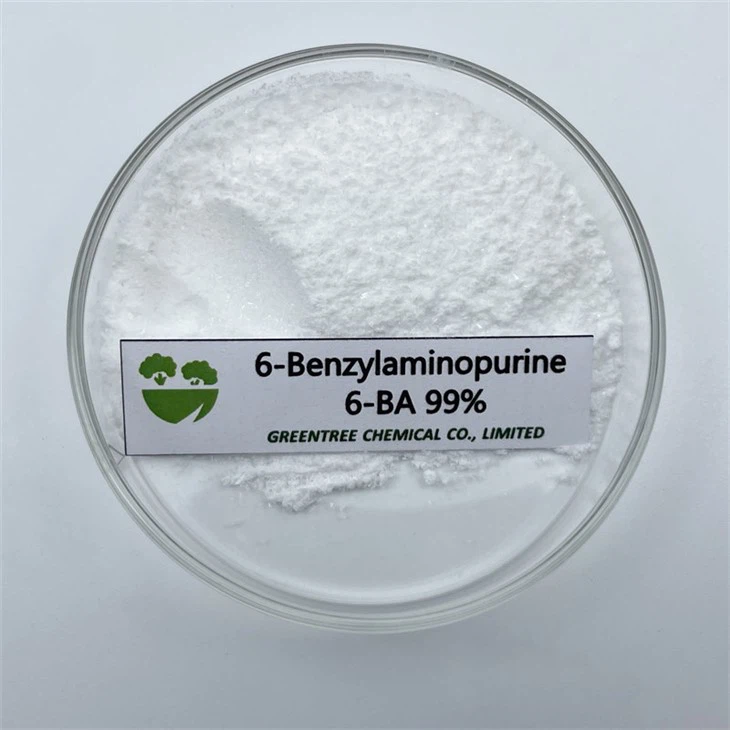
If you're looking for 6 - BA, we have CAS NO. 1214 - 39 - 7 6 - BA 6 - Benzylaminopurine 99% Plant Growth Regulator. It's a well - known plant growth regulator that's widely used in the industry.
Our Plant Growth Regulator 6 - KT 98% is also a great option. It has all the benefits of kinetin and is of high purity.
And for those looking to increase the set of fruit, our Plant Hormone Forchlorfenuron Cppu 99 Tc for Increasing The Set of Fruit is a top - notch product.
If any of these products sound interesting to you, don't hesitate to reach out and start a conversation about purchasing. We're always happy to help you find the right plant growth regulators for your needs.
References
- Smith, J. (2018). Plant Growth Regulators: Chemistry and Applications. Academic Press.
- Jones, A. (2020). Cytokinins in Plant Biology. Springer.