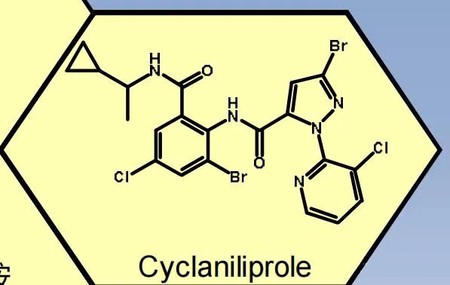
Cyclaniliprole is a bisamide insecticide with an o-carboxamidobenzamide structure. It was launched in 2017 and is now registered and listed in the United States, Canada, Australia, Brazil and other countries.
Cyclaniliprole is broad-spectrum, highly effective, with low dosage and long lasting effect. Used for fruit trees, vegetables, potatoes, tea trees, soybeans, cotton and other crops to control Lepidoptera, Coleoptera, Thysanoptera, Diptera, Hemiptera pests, etc., and is effective against resistant pests.

Mechanism of action and application
Cyclaniliprole belongs to the bisamide insecticides, but unlike other bisamide insecticides, it mainly acts on fish nitin receptors. Its main site of action is the isomer of the fishedin receptor, which opens calcium ion channels by binding to specific sites on the fishedin receptor in the mitochondrial membrane. The calcium ions in the cells are continuously released and combined with matrix proteins in the sarcoplasm, quickly causing the target pest's muscles to continue to contract and atrophy, showing convulsions, paralysis, refusal to feed, and eventually death. The International Insecticide Resistance Action Committee (IRAC) classifies it as group 28, nicotine receptor modulators. Also members of the same group include chlorantraniliprole, cyantraniliprole, flubendiamide, and tetrapyraniliprole.
Cyclaniliprole has gastrotoxic, contact and systemic effects. It enters the body of pests through feeding and skin penetration and exhibits rapid and efficient insecticidal activity.
Cyclaniliprole has a wide range of applications, not only for fruit trees, vegetables, potatoes, tea trees, soybeans, cotton and other crops, but also in non-agricultural fields. It has a wide control spectrum and has high biological activity against larvae and adults of Lepidoptera, Coleoptera, Thysanoptera, Diptera, and Hemiptera pests, and is not affected by temperature. In addition to directly killing the larvae and adults of target pests, cyclaniliprole can also inhibit egg-laying by female adults.
Cyclaniliprole has low dosage, long lasting effect and is safe for crops. Indoor biometric test results show: At a concentration of 50 mg/L, the lethality rate of cyclaniliprole to older nymphs and pupae of silver leaf whitefly is >80%, the lethality rate to cotton aphid larvae is >90%, and the lethality rate to palm thrips larvae is >90%; at a concentration of 12.5 mg/L, the lethality rate for the older nymphs and pupae of the leafminer is >90%, and the lethality rate for the larvae of the ladybug is >90%; at a concentration of 3.1 mg/L, the lethality rate to Spodoptera litura larvae is >90%. At a concentration of 200 mg/L, the lethality rate to adult houseflies is >90%; at a concentration of 5.3 mg/L, the lethality rate for adult feline ctenophores is >90%; at a concentration of 500 mg/L, the lethality rate for domestic termites is >90%.
Field efficacy test results show that 50 g/L cycloniliprole soluble agent has good control effect on rice leaf roller and cabbage exigua, and has a long-lasting effect. For foliage treatment, the dosage of active ingredients is 16-24 g/hm2.
Cyclaniliprole has a novel mechanism of action, so it is effective against resistant pests, such as resistant diamondback moth, and can be used for resistance management. In order to overcome and delay pesticide resistance and extend the life cycle of pesticides, effective methods are formulated. At present, in addition to single-dose products, products compounded with cyclaniliprole, flunicamid, acetamiprid, etc. have been commercialized. In addition, research on its compound formulations is also in progress: the combination of Cyclaniliprole and triflufen or fenfentrile has a synergistic effect. Combined with difenthiuron, it has obvious synergistic effect and can reduce the cost of pesticide use. Combined with indoxacarb, it has a wide range of applications and good effects. It is compounded with methoxyfenozide to reduce the dosage of pesticides and has a synergistic effect on lepidopteran pests such as diamondback moth and borer borer. Combined with matrine, the control effect is significantly improved. Combination with avermectin, spinosad, and emamectin benzoate improves the efficacy.
Summarize
Cyclaniliprole, as a new bisamide insecticide, has a broad insecticidal spectrum, low dosage, and long duration of effect. It is effective against multi-insectic Lepidoptera, Hemiptera, Thysanoptera, Diptera, Coleoptera pests and their resistant pests. At the same time, cyclaniliprole has less impact on mammals, beneficial arthropods, and the environment. With the ban and restriction of neonicotinoid pesticides in some countries and regions, cyclaniliprole can be used as a substitute for neonicotinoid pesticides in some markets, and can also be regarded as an important supplement to chlorantraniliprole.
The mechanism of action of Cyclaniliprole is different from other bisamide insecticides, and it has huge market potential in the field of resistant pest control in the future. Currently, cyclaniliprole has been registered and marketed in many countries and regions around the world, and the compound patent will expire in 2025.