


Chlorantraniliprole is a bisamide product developed by DuPont in the United States. It initially shined in the market due to its excellent control effect against lepidopteran pests. With the long-term use of chlorantraniliprole in the market, its control effectiveness and resistance have reached an inflection point.
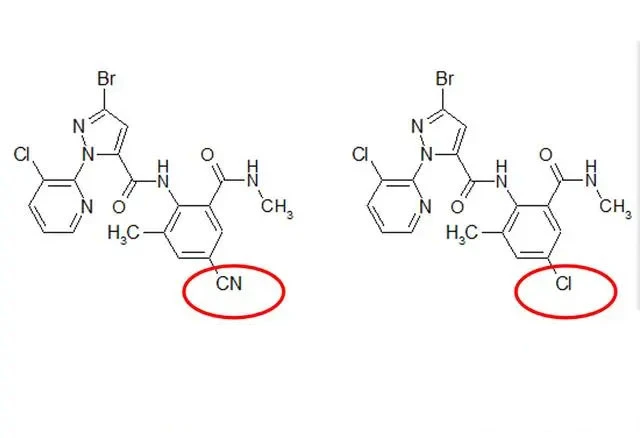
Cyantraniliprole Overview
Cyantraniliprole is the second bisamide insecticide developed by the original DuPont Company after chlorantraniliprole. It has a broad insecticidal spectrum and has both stomach poisoning and contact killing effects. It not only controls Lepidopteran pests, but also Hemiptera, Coleoptera and Diptera pests. It can be used on corn, sugar cane, cotton, cereals, rice, fruit trees and vegetables, etc., and is particularly active in controlling whiteflies, thrips, aphids, stink bugs, American leafminers, beet armyworms, stem borer, stem borer, fruit flies and beetles, etc., for whiteflies (including B-type and Q-type Bemisia tabaci, etc.), leafminers and beetles, and rice leaf rollers.
As a representative of the diamide insecticides that act on the fish nytin receptors, cyantraniliprole and chlorantraniliprole are from the same family and are the second generation fish nicotine receptor inhibitor insecticides.
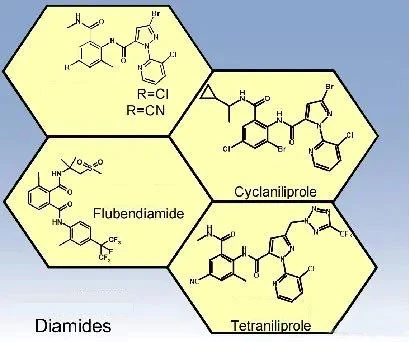
In addition to its high permeability, conductivity, chemical stability, and high insecticidal activity, cyantraniliprole also has strong systemic activity. It can control not only chewing mouthparts pests, but also piercing-sucking mouthparts pests, including Lepidoptera, Diptera, Thysanoptera, Hemiptera and Coleoptera pests. It kills insects more thoroughly and is suitable for a wide range of crops.
Mechanism of action and application
Cyantraniliprole, like chlorantraniliprole, is a fish-receptor insecticide. Mainly by activating the fish nicotine receptor in the target pest's body, the fish nicotine receptor can release calcium ions stored in the striated muscle and smooth muscle cells, which can cause muscle movement regulation disorder and paralysis in the pest within a few minutes, causing the pest to quickly stop feeding and ultimately die.
Cyantraniliprole has systemic, penetrating and conductive effects. After spraying, it can be quickly transmitted to all parts of the plant and distributed throughout the plant. Effectively prevent pest damage, the treated crops will grow strong and have bright leaves, and it can also increase crop yields.
Bioassay of toxicity
In the pesticide market, bisamide compounds have attracted much attention and have now become one of the important categories in the pesticide market and the fastest growing category of chemical pesticides.
summary
Cyantraniliprole is an analogue of chlorantraniliprole. Compared with the two, cyantraniliprole is suitable for crops and has a wider insecticidal spectrum. Currently, cyantraniliprole has been used in fruits, vegetables, rice, ornamental nurseries, greenhouse crops, lawns, etc. to control stem borer, stem borer, pod borer, melon borer, cotton bollworm, and beet armyworm, cabbage caterpillar, whitefly, whitefly, aphids, leafminer, thrips, grubs, cutworms, Spodoptera exigua and other pests. In addition, it is also used in non-agricultural fields, such as sanitation and insecticide. As an inhibitor of fish nicotine receptors, cyantraniliprole has strong killing power against target pests, is safe for mammals, and has good environmental compatibility.
Cyantraniliprole was launched in 2012 and now covers major agricultural producing countries around the world, including Brazil, China, India, Japan, the United States, Canada, Australia, etc. Cyantraniliprole was originally produced and sold by DuPont. Through continuous authorization and cooperation, many companies have participated in its market development, including Syngenta, Bayer, Agro-Kanesho, Combinatorial Chemical, Sumitomo Chemical, and Soda of Japan. With the joint efforts of FMC, Syngenta, Bayer and many Japanese companies, cyantraniliprole is used in more and more markets, and the product categories are becoming more and more abundant.
No product can circumvent resistance. Resistance to cyantraniliprole develops relatively quickly. In some areas, Bemisia tabaci populations have developed resistance to it at a moderate level or above. In order to delay the occurrence and development of resistance, cyantraniliprole should be used in rotation with agents with different mechanisms of action, or in combination with agents with other mechanisms of action.


