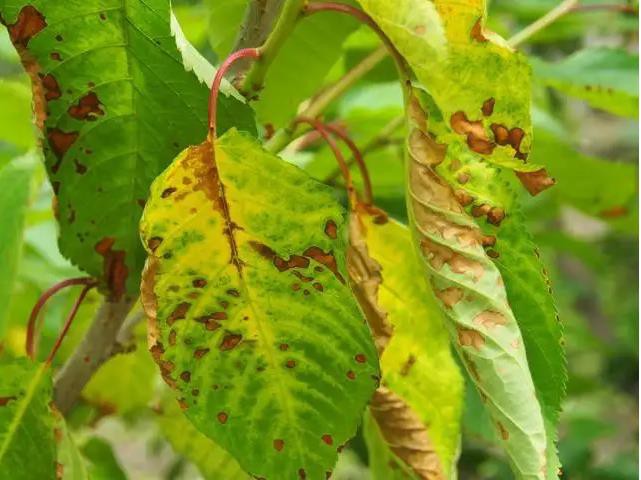
Usually we see that the leaves have spots, yellowing, burning, and stop growing, which are all manifestations of phytotoxicity. Of course, not only fungicides, but also pesticides have this problem, and even fertilizers have this problem. For example, when we use potassium dihydrogen phosphate, it is easy to burn leaves and cause phytotoxicity when used in high temperature periods.
1. Fungicides such as oxamidil are only suitable for root irrigation and soil mixing, and are not suitable for leaf and seedling spraying, especially at the seedling stage.
2. We should pay special attention to pyrimethamine when using it, and use it when the temperature cannot exceed 30 °C, which is easy to cause phytotoxicity.
3. Chlorothalonil is widely used by farmers and friends, but it is best not to use this fungicide on fruit trees.
4. Prochloraz should be used in strict accordance with the regulations, and cannot be used in arbitrary amounts, which will inhibit the growth of crops. And often when we are spraying, we tend to use a little more, which may not make the crop look obvious, but it may have inhibited its growth.
5. When using ethalicin, the temperature should not exceed 30℃. When the temperature is high, no matter which method is used, it is easy to cause phytotoxicity.
6. Succinate dehydrogenase inhibitors, there are many such pesticides, such as our commonly used fluoxamid, fluopyram, pyraclostrobin, etc. are all this kind of agent, which is a relatively high-end agent at present . Such pesticides should not be mixed with pesticides containing metal ions, and the temperature should not exceed 30 ℃ when used, and should not be mixed with fertilizers, it is very easy to cause phytotoxicity.
7. Like our commonly used fungicides such as pyraclostrobin, azoxystrobin, trioxystrobin, fenoxystrobin, picoxystrobin, syringostrobin, etc., it is best to reduce the amount during the seedling stage of crops It is easy to cause high local concentration and phytotoxicity. It is best to use it together with brassinolide. Also, do not mix with silicones, emulsifiable concentrates and other additives. Because such fungicides are inherently malleable, they are not only wasted but also produce other reactions.
8. Triazole fungicides such as triazole, difenoconazole, triazolone, dinoconazole, paclobutrazol, tebuconazole, hexaconazole, epoxiconazole, flusilazole, etc. are very strong inhibitory effect. Of course, triconazole and difenoconazole would be better. Therefore, we can only use these fungicides on grass crops such as corn, wheat, rice and beans with confidence. Other crops, such as fruit trees and vegetables, are very prone to phytotoxicity, so be careful!
9. For copper preparations such as copper hydroxide, Bordeaux mixture, copper quinoline, copper rosinate, copper thiophanate, etc., farmers and friends should not use it together with potassium dihydrogen phosphate, nor increase the concentration at will. The concentration of the superscript is based on this, and it cannot be increased arbitrarily. Otherwise, if there is a drug injury, it will be useless to find anyone, or you will suffer the loss yourself.
In addition, when the temperature exceeds 30 °C, it is not necessary to use it. If you really want to use it, you must use it with caution and reduce the concentration of use. It is very easy to cause phytotoxicity.
Don't use it when there is dew, and don't use it for more than 12 hours with high humidity, it is easy to cause phytotoxicity.
The use time of this kind of copper preparation should not be less than 15 days from the sulfur-containing fungicide, which is easy to cause phytotoxicity. Like our commonly used sulfur, lime sulfur mixture, mancozeb, mancozeb, etc. are all sulfur-containing fungicides, and special attention should be paid when using them.