symptom
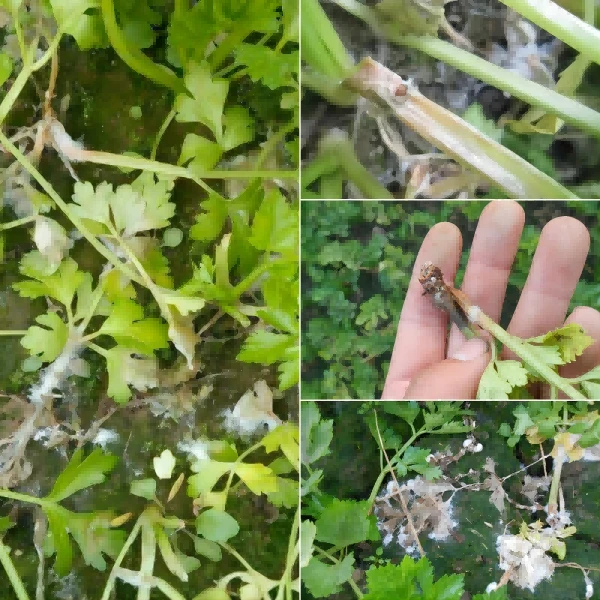
Damages the petiole base and root neck of celery near the ground. The affected part is brown water-soaked at the beginning, soft rot appears when the humidity is high, white hyphae grow on the surface, and then black sclerotia like rat droppings are formed.
Pathogen
Sclerotinia sclerotiorum (Lib.) de Bary, also known as Sclerotinia sclerotiorum, belongs to the genus Sclerotinia sclerotiorum of the fungal kingdom Ascomycota.
Transmission routes and disease conditions
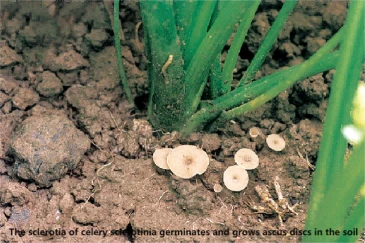
Overwinter with sclerotia in the soil or mixed with seeds, and become the source of infection in the early next year. Ascospores are ejected from the ascus disc or spread by wind and rain, infecting old leaves or petals. Field reinfection is mostly carried out by mycelia. There are two ways for mycelia to infect and spread: one is that the fallen diseased tissue contacts the leaves and stems and the mycelium spreads on it; the other is that the diseased leaves directly contact with the healthy leaves and stems, and the mycelia on the diseased leaves directly contact with each other. Spread makes it sick. The temperature limit for sclerotia germination is 5-20°C, with 15°C being the optimum temperature. The relative humidity above 85% is conducive to the occurrence and prevalence of the disease.

Prevention method
① Implement 3-year crop rotation.
② Select the seeds from the disease-free plants or use 10% salt water to select the seeds before sowing, remove the sclerotium, rinse with clean water, dry and sow.
③ Deep plow or soak in water or close the shed for 7 to 10 days after harvest, and use high temperature to kill the surface sclerotia.
④Use plastic film to prevent ascus disk from being unearthed and reduce the incidence.
⑤Use ecological control method to avoid occurrence of disease conditions.
⑥ In the early stage of the disease, spray 1500 times of 50% boscalid water-dispersible granules or 600 times of 40% Sclerotin WP 1 day before watering, or 1000 times of 50% cyprodinil water-dispersible granules.
⑦ The shed uses 10% procymidone smoke agent or 10% fluroma·manganese zinc dust agent.