symptom
① Nitrogen deficiency. The lower leaves turn white to yellow, and the growth is poor.
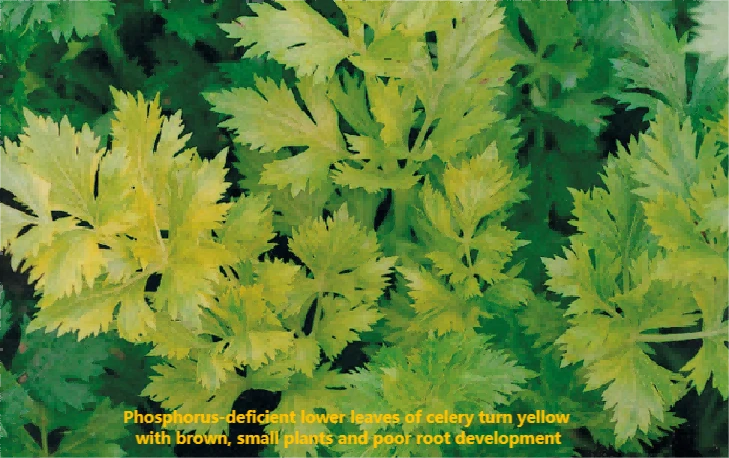
②Phosphorus deficiency. The lower leaves start to turn yellow, but the leaf color of young leaves is darker than that of nitrogen deficiency.
③ Potassium deficiency. While the lower leaves are yellowing, brown spots appear between the veins, and this symptom gradually spreads to the upper leaves, and the growth becomes poor.
④ Calcium deficiency. The growth and development of the growth point is blocked, the young leaves in the center die, and white to brown spots appear between the top leaf veins of the nearby new leaves.
⑤ iron deficiency. Celery cultivated without soil is prone to iron deficiency. On the young leaves, intervein yellowing occurs first, and when severe, the leaves turn white.
⑥ lack of sulfur. The whole plant is light green, but the young leaves show a special light green color.
⑦ Magnesium deficiency. Yellowing occurs along the sides of the veins and gradually spreads from the lower leaves to the upper leaves.
⑧ boron deficiency. When celery's absorption of boron is hindered, stem cracks often occur, and most of the stem cracks are born on the outer leaves, mainly on the inner part of the epidermis. Boron deficiency occurs when the heart lobe develops, the inner tissue of the heart lobe becomes brown and cracks, and the growth is poor.
⑨ manganese deficiency. Pale green to yellowish white appears between the veins at the leaf margin.

Etiology
① Nitrogen deficiency. Newly opened vegetable fields or plots with little soil organic matter and insufficient nitrogen supply capacity are planted with fast-growing celery, which is prone to nitrogen deficiency diseases.
②Phosphorus deficiency. One is insufficient phosphorus supply in the soil. When the soil pH value is 6.5-7, the soil available phosphorus content is the highest. If it is lower or higher than this range, the soil available phosphorus is insufficient. Second, low temperature can reduce the absorption of phosphorus by celery.
③ Potassium deficiency. Celery mainly absorbs nitrogen and phosphorus in the early stage of growth and development, and changes to absorb nitrogen and potassium in the middle and late stages of growth and development. Potassium deficiency is prone to occur in red-yellow soil. The potassium absorbed by celery is 2 times higher than that of nitrogen, and the celery field with continuous cropping is also prone to potassium deficiency.
④ Calcium deficiency. Calcium deficiency in celery is caused by soil acidification, especially in old protected areas.
⑤ iron deficiency. Iron deficiency is not easy to occur under the conditions of protected land with soil as the substrate, but sometimes iron deficiency can be induced by the excess of manganese in the soil.
⑥ lack of sulfur. When cultivating celery in protected areas in greenhouses, sulfur deficiency is prone to occur when fertilizers without sulfate radicals are continuously applied for a long time.
⑦ Magnesium deficiency. When ammonium nitrogen accumulates in the soil of the protected area, it will cause the absorption of magnesium, and magnesium deficiency occurs. When there is too much potassium fertilizer in production, it is easy to cause magnesium deficiency.
⑧ boron deficiency. Celery needs a lot of boron when it grows heart leaves. If the supply of boron is insufficient, it will cause boron deficiency.
⑨ manganese deficiency. Manganese deficiency is prone to occur on alkaline, calcareous, and sandy acidic soils. Excessive iron, copper, zinc and other ions in the soil can also induce manganese deficiency.
Prevention method
Every 4000kg of celery needs to absorb 7.3kg of nitrogen, 2.7kg of phosphorus, 16kg of potassium, 6kg of calcium, and 3.2kg of magnesium. Based on this, soil testing and formula fertilization are carried out. The actual amount of fertilizer applied in production, especially the application amount of nitrogen and phosphorus fertilizers, is 2 to 3 times higher than the actual amount of fertilizer required, which means that celery is a crop with low fertilizer absorption capacity and high fertility resistance. Only when the celery is in a certain state can it absorb a large amount of fertilizer, and the insufficient amount of fertilizer will not only affect the normal growth and development of celery, but also the quality is not good.
The nitrogen concentration suitable for the growth of celery leaves is 200mg/kg, the available phosphorus content in the soil is preferably 150mg/kg, and the potassium concentration is 120mg/kg, especially in the late growth period. When fertilizing in production, add 2% to 3% calcium superphosphate to the nutrient soil for seedling fertilizer, and topdress with low-concentration nitrogen fertilizer once 30 days after emergence as appropriate, and topdress with 0.2kg of ammonium sulfate or decomposed thin human excrement per border. Apply 4000-5000kg of decomposed organic fertilizer, 30-35kg of superphosphate, and 15-20kg of potassium sulfate per 667m2 of base fertilizer, and apply 1-2kg of borax to boron-deficient plots. In the seedling lifting stage, topdress 10kg of ammonium sulfate per 667m2 with water, or 550kg of decomposed human excrement.
When most of the new leaves are exhibited until harvesting, a large amount of fertilizer is required for a long time. Topdressing urea 8kg or ammonium sulfate 18kg, potassium sulfate 13kg per 667m2 each time. After half a month, the celery enters the flourishing period for the second top dressing, and after another 15 days for the third top dressing, the amount of fertilizer is the same as the first time.
Excessive nitrogen and potassium concentrations in the soil will affect the absorption of boron and calcium, causing the young tissues of celery heart leaves to turn brown or appear dry edges, which will be more serious when watering is insufficient, the soil is dry or the ground temperature is low, so nitrogen fertilizer should be controlled 1. Increase the amount of potassium fertilizer, increase the application of boron fertilizer and calcium fertilizer, keep the soil moist and prevent the soil temperature from being too low. When boron deficiency symptoms such as stem cracks are found, 0.5% borax aqueous solution is sprayed on the leaves. When heart rot occurs in production, spray 0.3% to 0.5% calcium nitrate or calcium chloride aqueous solution on the leaves. In addition, Tianda 2116 Zhuangmiaoling 600 times liquid can also be sprayed to increase production significantly.