Organic nitrogen pesticides are a new class of pesticides developed after the 1970s. This type of pesticides refers to organic synthetic pesticides that contain "nitrogen" atoms in their structural formulas, in addition to organophosphorus or carbamate pesticides. This type of insecticide has attracted attention because of its insecticidal mechanism that is different from organophosphorus and carbamate insecticides.
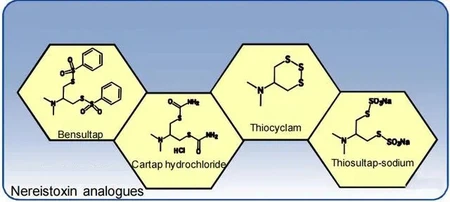
This type of insecticide has strong stomach poisoning and contact killing effects on pests, and also has certain fumigation and egg-killing effects. Some varieties have antifeedant and avoidance effects. Most varieties of this type of pesticides have strong systemic conductivity and can be absorbed by the roots, leaf sheaths and leaves of crops and conducted in the body. Some varieties can not only conduct upwards, but also have bidirectional conduction capabilities. It has good selectivity against pests and is highly toxic to some pests, but not very toxic to other pests. For example, thiocyclam has strong toxicity to rice borer, rice borer, giant borer and leaf roller, but less toxic to rice leafhoppers, rice planthoppers, etc.
Chlorpyrifos
Chlorpyrifos belongs to the Nereosin class of insecticides and is a nerve poison. After insects come into contact with and feed on the agent, they will become dull, slow in movement, lose the ability to damage crops, stop development, soften the insect body, become paralyzed, and eventually die. Chlorpyrifos has a strong systemic effect and can be absorbed and transmitted by the leaves and roots of crops.

Main preparations: 18% aqueous agent, 45% soluble powder, 3.6% large granules, etc.
Prevention and control objects: Rice borers, leaf rollers, rice bracts, thrips, leafhoppers, planthoppers, vegetable cabbage caterpillars, diamondback moths, and cabbage borers. Corn armyworm, apple aphid, pear star caterpillar, citrus leaf miner, Damour swallowtail butterfly, etc.
Monosultap
Monosultap is a related species of chlorpyrifos, which is a disodium salt, and monosultap is a monosodium salt. Monosultap is also a synthetic analog of Nereisin, which is quickly converted into Nereisin or dihydroNereisin when it enters the body of insects. This drug is a competitive inhibitor of acetylcholine, has strong contact killing, gastric poisoning and systemic conduction effects, and has a good control effect on the larvae of lepidopteran pests. This drug is mainly used to control pests on sugarcane, rice and other crops.
According to the characteristics of monosultap, monosultap should not be used alone. Since monosultap has different action mechanisms from abamectin, chlorantraniliprole, Bacillus thuringiensis, organophosphorus and other insecticides, it can exert its strong systemic and powerful ovicide effects when mixed with these agents. It has a good synergistic effect on the control of stem borer, so monosultap can be used in combination with abamectin, chlorantraniliprole, etc. Or choose compound preparations such as Avi·monosultap and monosultap·chlorantraniliprole.

Control objects: Rice borer, rice borer, leaf roller, cabbage caterpillar, sugarcane borer, corn borer, etc.
Cartap
A derivative of Nereis toxin with broad spectrum, it can be used to control various pests and nematodes such as Lepidoptera, Coleoptera, Hemiptera, Diptera and so on. Little impact on predatory mites. Its toxicological mechanism is to block the transmission of impulses at nerve cell junctions in the central nervous system, paralyzing insects.
Main preparations: 50% soluble powder, 4% granules.
Prevention and control objects: Cartap can be used to control a variety of pests and nematodes such as Lepidoptera, Coleoptera, Hemiptera, and Diptera, and has little impact on predatory mites.
Thiocyclam
It is a Nerei toxin insecticide that has contact and gastric poisoning effects, as well as certain systemic and fumigation effects, and can kill eggs. The poisonous effect on pests is relatively slow, and those with mild poisoning can sometimes be revived. It disappears quickly in plants, has a short residual period, and leaves very little residue in crops at harvest. Thiocyclam is effective against Lepidoptera, Coleoptera, and Homoptera pests, and can be used to control a variety of pests on rice, corn, sugar beets, fruit trees, and vegetables. Thiocyclam has excellent insecticidal effect on thrips, whitefly nymphs and adults, but has poor egg-killing effect and a short duration of effect.
At present, the thiocyclam market is mainly single-dose and thiocyclam·acetamiprid, thiamethoxam·thiocyclam, spinosad·thiocyclam, etc., and the number of registrations is not large.

Control objects: It has good control effect on Lepidoptera and Coleoptera pests, mainly controlling rice borers (large borers, borer borers, and borer borers), rice bracts, leaf rollers, rice planthoppers, and rice leafhoppers. Tea green leafhoppers, tea geometrids, fruit tree pests such as peach aphids, apple aphids, apple red spider mites, and pear star caterpillars.