Bisamide insecticides are one of the insecticide products with the greatest market potential after neonicotinoid insecticides. Cyantraniliprole, also called cyantraniliprole, is the second-generation fish-nidin receptor inhibitor insecticide successfully developed by DuPont (now FMC) after chlorantraniliprole. Cyantraniliprole is produced by changing various polar groups on the benzene ring of chlorantraniliprole. Compared with chlorantraniliprole, in addition to having the good permeability, conductivity, chemical stability, and high-efficiency insecticidal activity of chlorantraniliprole, it also has better systemic properties. It has stomach poisoning and contact killing effects at the same time, killing insects more thoroughly. It can be used in some environments where resistance to chlorantraniliprole occurs. It is applicable to a wider range of crops and has a wider range of insecticides. It can effectively control not only Lepidoptera, but also Hemiptera, Diptera and Coleoptera pests. It is especially active against sucking pests such as thrips, whitefly, and whitefly, making it a better insecticide product than chlorantraniliprole.

Product introduction
Product Name: cyantraniliprole
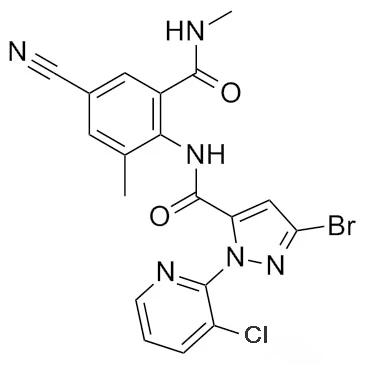
Chemical Name: 3-Bromo-1-(3-chloro-2-pyridyl)-N-{4-cyano-2-methyl-6-[(methylamino)carbonyl]phenyl}-1H-pyrazole-5 -Formamide
Trade Names: Beneval ®, Vodonon ® and Verima ®
CAS NO.: 736994-63-1
Molecular Formula: C19H14BrClN6O2
Molecular Weight: 473.7
Structural Formula:
Physical and chemical properties
Melting Point: 224℃
Boiling Point: Decomposes before boiling
Vapor Pressure (25℃): 5.13×10⁻¹²mPa
Octanol/Water Partition Coefficient: KowlogP=2.02 (20℃)
Solubility: Solubility in water (20°C) is as low as 14.2 mg/L.
Organic solvent solubility (20°C, mg/L): acetone 6540, ethyl acetate 1960, toluene 576, methanol 4730.
Stability: soil degradation DT50 (typical soil) 34.4d, 34.4d (laboratory soil, 20℃), 32.4 (field soil). Under the conditions of 20℃ and pH7, hydrolysis DT50=61.
Mechanism of action
Mainly by activating the fish nitin receptor in the target pest, and after the fish nitin receptor is activated, it can release calcium ions stored in the striated muscle and smooth muscle cells. It can cause disorder and paralysis of the pest's muscle movement within a few minutes, causing the pest to quickly stop feeding and eventually die. Cyantraniliprole has strong systemic properties and can be transferred in the xylem. Therefore, no matter spraying, root irrigation, or mixed application in the soil, good insecticidal effects can be achieved.
Application and insecticide spectrum
Application: Cyantraniliprole is suitable for many crops, including field crops, fruit trees and vegetables. Including but not limited to pumpkin, green onions, cabbage, cotton, rice, corn, cabbage, tomatoes, watermelon, cowpeas, peas, peppers, cucumbers, etc.
Insecticide spectrum: It can control not only chewing mouthparts pests, but also piercing-sucking mouthparts pests, including Lepidoptera, Coleoptera, Diptera and Hemiptera. Including whitefly, whitefly, rice leaf roller, stem borer, stem borer, thrips, aphids, American spotted fly, pod borer, melon silk borer, cotton bollworm, fruit fly and beetles and other pests. At the same time, it can also prevent and control underground pests such as grubs, cutworms, and Spodoptera exigua.
Use technology
Dosage: The dosage of active ingredients is 10~100 g/hm2.
Usage: foliar spray, seed treatment, soil treatment, etc. can be used. Resistance to cyantraniliprole develops rapidly. In some areas of my country, whitefly populations have developed moderate to high levels of resistance to cyantraniliprole. The resistance of whitefly eggs to cyantraniliprole has reached 11 to 1,002 times. Therefore, when using medication, attention should be paid to alternating and rotating the use of agents with different mechanisms of action or the use of compound preparations to delay the development and development of resistance. When compounded with pesticides with other mechanisms of action, thiamethoxam, acetamiprid, abamectin, ethiprofen, etc. can be preferred. In addition, it can be compounded with fungicides for seed treatment, such as compounding with isothiastrobin, triflufenac, etc.
Characteristics of Cyantraniliprole
1. Broad insecticidal spectrum: Cyantraniliprole can prevent and control not only chewing mouthparts pests, but also piercing and sucking mouthparts pests.
2. Unique mechanism of action: Compared with other traditional broad-spectrum pesticides, cyantraniliprole has a unique mechanism of action. For example, organophosphorus and pyrethroids have a new mechanism of action, which affects insect behavior by weakening muscle function, causing pests to quickly stop feeding, and reducing the occurrence of viral diseases transmitted by insect vectors.
3. Flexible use methods: Cyantraniliprole has very significant systemic characteristics and can be transferred in the xylem. Therefore, good insecticidal effects can be achieved regardless of spraying, root irrigation, or mixed application in soil.
4. Good compoundability: It can be compounded with other pesticides or fungicides for seed treatment.
5. Acts on multiple stages of pests: Cyantraniliprole can affect multiple developmental stages of pests, including the reproductive stage, achieving more effective prevention and control by reducing the growth of pest populations.
6. Selective to beneficial arthropods:Its impact on non-target organisms is minimal or even negligible. Scorpions, centipedes, spiders, etc.
7. Environmentally friendly: Green and environmentally friendly, safe for applicators, and can also be used in fish and shrimp fields.
Future compounding recommendations
Cyantraniliprole + buprofen: It can control a variety of pests, has obvious synergistic effect, and expands the insecticidal spectrum. It has high activity against flea beetles, aphids, thrips, stem borers, stem borers, rice leaf rollers, rice planthoppers, leafhoppers, scale insects, citrus leafminers and tea green leafhoppers.
Cyantraniliprole + pymetrozine, fenfentrile, ethiprofen, pyriproxyfen, lufenuron: Can be used on rice, wheat, cruciferous vegetables, tea trees, cotton, fruit trees, and ornamental flowers. Control rice planthoppers, brown planthoppers, gray planthoppers, rice leaf rollers, stem borers, stem borers, aphids, whitefly, beet armyworm, diamondback moth, cabbage caterpillar, leaf miner, rust tick, etc.
Flupron + Cyantraniliprole: It has high activity on rice leaf rollers, stem borers, stem borers, cabbage caterpillars, beet armyworms, Spodoptera litura, corn borers, cotton bollworms, etc. on rice, vegetables, corn, cotton, and fruit trees.
Cyantraniliprole + dinotefuran, imidacloprid, acetamiprid, nitenpyram, thiamethoxam, thiacloprid, clothianidin: Used to control Lepidoptera, Hemiptera, Hymenoptera, Coleoptera and other pests. It also has obvious synergistic effect and expanded insecticidal spectrum. It is highly active against sucking pests such as planthoppers, aphids, green leafhoppers, whiteflies and lepidopteran pests such as diamondback moth and beet armyworm.
Abamectin/emamectin + cyantraniliprole: The control effect is significantly improved through compounding. Compared with single dose use, the control effect % increased by up to 12.02% 10 days after treatment. Under the same control effect, it can significantly reduce the dosage of pesticides, environmental pollution, and residues of agricultural products; the application method in preventing and controlling rice leaf rollers is simple and has significant control effects.
Cyantraniliprole + spinosad: It can prevent and control lepidopteran pests on crops, especially for the control of cotton bollworm and borer. Its effect is significantly higher than that of a single agent.
Cyantraniliprole + indoxacarb: It can produce a high synergistic effect, overcome and delay pest resistance, kill insects quickly, have a long duration of effect, reduce the cost of medication, and the control effect is significantly higher than its single agent use.
Synthetic Route
There are two main synthetic routes for cyantraniliprole:
Route 1: Ring-opening of oxazinone and methylamine to obtain cyantraniliprole. This method has a short reaction time and simple operation, while the intermediate azinone is prepared from pyrazole carboxylic acid and aniline acid or pyrazole acid chloride and isatoic anhydride, and the operation is relatively complicated and the reaction time is long.
The reaction is as follows:

Route 2: The reaction between pyrazole carboxylic acid and anthranilic acid in the presence of methylsulfonyl chloride and acid binding agent produces cyantraniliprole.
The reaction formula is as follows:

Outlook
As a major agricultural country in my country, pesticides play a very important role in the prevention and control of pests and diseases. With the continuous improvement of the level of social and economic development, people's quality of life has been significantly improved, and people have also put forward higher requirements for the effectiveness, safety, and environmental protection of pesticides. Traditional organophosphorus, carbamate, pyrethroids and nicotine have been used for many years, and problems such as toxicity and resistance have become prominent. Amide pesticides have unique targets, low toxicity, and both contact and systemic properties, making them widely used in many countries as an important means of pest control. Fish-receptor pesticides also represent the main direction of pesticide production in the new era. However, as a highly efficient pesticide, especially Kangkuan, which has the same mechanism of action, the resistance in China is already very serious. As far as the current cost is concerned, the promotion direction of cyantraniliprole is mainly high-yield crops. It is believed that with the expiration of patents and the increase of domestic production capacity, the reduction of costs will be an important help for bisamide insecticides to seize market share.
Source: AgroPages