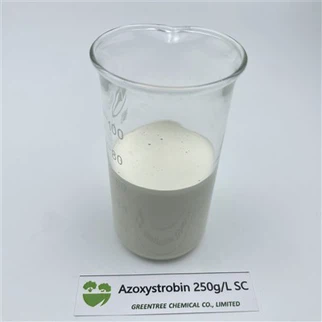
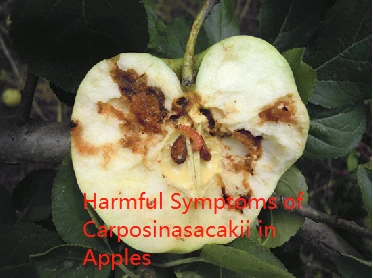
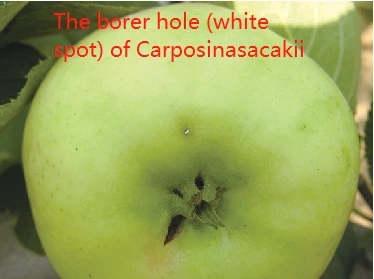
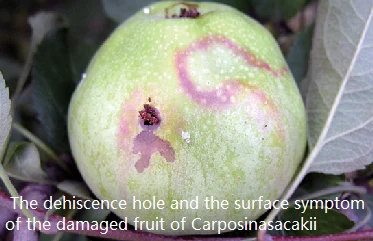
Carposinasacakii, referred to as "peach small" for short, uses larvae to bore fruit. Shortly after the larvae bore the fruit, the damaged fruit can leave teardrop-shaped colloidal spots from the fruit entry hole. As the fruit grows, the fruit hole heals into small black spots, and the surrounding peel is slightly sunken.
After the larvae enter the fruit, they eat the pulp under the skin, and the fruit surface shows concave latent marks. The infected fruit is filled with insect excrement, forming a "bean paste filling". When the larvae are mature, they bite an obvious hole in the fruit surface and drop off the fruit.
Morphological characteristics
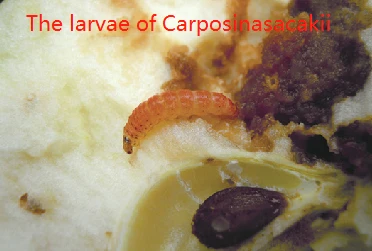
The adult body is 5-8 mm long, gray-white to gray-brown, with a large glossy near-triangular blue-black spot in the middle of the forewing, and 7 clusters of oblique blue-brown scales at the base and middle. The larvae are 9-16 mm in length when mature, the head and prothorax are yellowish brown, and the chest and abdomen are orange-red.
habit
Peach small heart eaters produce 1 to 2 generations a year, and overwinter as mature larvae in a cocoon of 3 to 13 cm. Flat orchards are mostly concentrated in the soil near the main trunk. In the second year, when the ground temperature of 5 cm reaches above 19°C, and the soil has a certain humidity, the excavation begins. After the larvae are unearthed, they crawl on the ground for a period of time, and then form a spindle-shaped summer cocoon to pupate in soil crevices, the crevices at the base of tree trunks, and under leaves. The pupal stage is about half a month. Adults start to lay eggs about 2 days after eclosion. The eggs are mostly laid in the depressions of the calyx of the fruit, but also in the depressions of the sepals or stems. The egg period is 6 to 8 days. After the newly hatched larvae crawl on the fruit surface for 2 to 3 hours, they mostly bore into the fruit from the carcass to cause damage. After the larvae are mature, they fall off the fruit and fall to the ground. Most of the fruit that falls off before mid-August become summer cocoons, and then pupate, emerge, lay eggs, hatch, and continue to harm. The second generation of larvae are used as cocoons to overwinter; in mid-August
After the fruit is removed, it will be directly buried in the soil to make winter cocoons for overwintering.
Adults are inactive during the day and active at night, without phototaxis and chemotaxis. Male moths have strong tropism to peach small sex attractants.
Prevention and control technology
(1) Ground chemical prevention and control From the time the overwintering larvae are unearthed, ground medicine is used. Use chlorpyrifos, or phoxim, or poisonous stimulant liquid to evenly spray the ground under the tree, spray the top soil, and then rake the soil surface to kill. Overwintering larvae.
Generally, mid-May after the orchard has rained or watered, it is the critical period for the ground control of peach heartworm. You can also use the small peach attractant to predict and determine the appropriate period of application. When the first male moth is lured, it is the period of ground application.
(2) Trapping and killing male adults From mid to late May, small peach attractants were hung in the orchard, 2 to 3 grains per mu, to trap and kill male adults. Replace the lure every 1.5 months. For isolated apple orchards without surrounding orchards, this measure can basically control the damage of peach small. However, for non-isolated apple orchards, it cannot be completely trapped and can only be used for insect forecasting to determine the spraying time.

(3) Spraying on trees to prevent and control the ground 20-30 days after spraying on the trees, or spraying on the trees before the egg and fruit rate is 0.5% to 1% and the newly hatched larvae before the fruit is eaten; Prediction of attractants, spray immediately when the peak of attracting moths occurs. Prevention and control of the second generation of larvae should be carried out 35 to 40 days after the first spraying. Once every 5 to 7 days, each generation should be sprayed 2 to 3 times. The agents with better effect are: beta-cypermethrin, Lambda-cyhalothrin, bifenthrin, phoxim, abamectin, Emamectin Benzoate, chlorantraniliprole, etc. It is required that the spraying must be timely, uniform and thoughtful.
(4) Fruit bagging Early implementation of fruit bagging can basically avoid the damage of small peaches.