Soil health plays a critical role in modern crop production. Continuous cropping, intensive cultivation and repeated planting of the same crops can lead to the accumulation of soil-borne pathogens, nematodes, harmful insects and weed seeds, which negatively affect crop establishment and yield.
Dazomet is a widely used soil fumigant and soil treatment active ingredient designed for pre-plant soil disinfection. After application into moist soil, Dazomet decomposes and releases methyl isothiocyanate (MITC), a volatile compound responsible for controlling many soil-borne pests.
Unlike conventional foliar pesticides, Dazomet works directly in the soil environment, making it suitable for crops where underground diseases and pests are major production challenges.
 Agricultural worker applying granular soil treatment product in vegetable field
 Greenhouse soil preparation using Dazomet soil fumigant before planting
What Is Dazomet and How Does It Work?
Chemical Characteristics of Dazomet
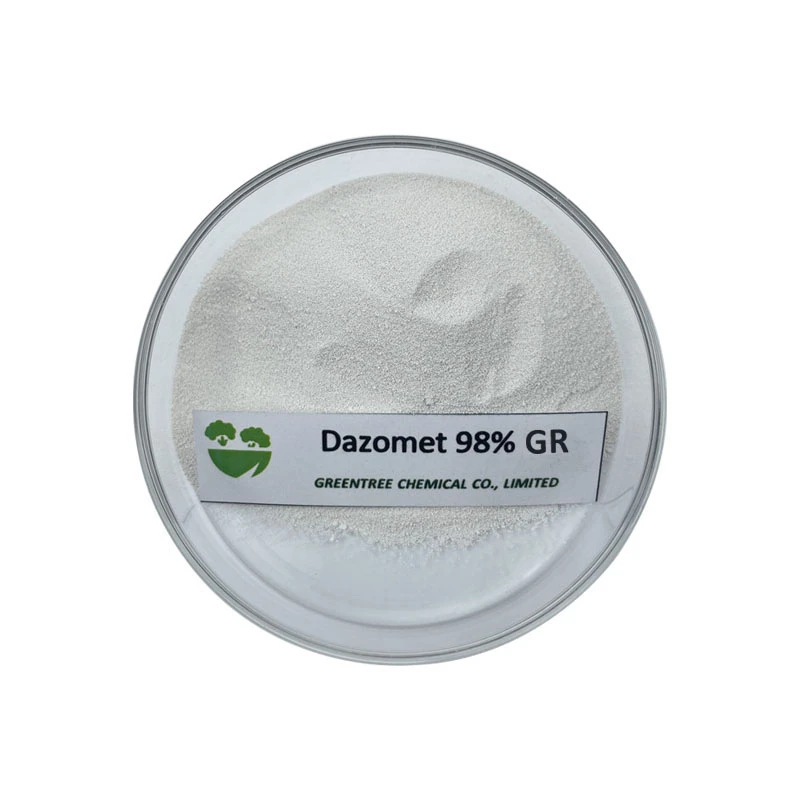
Dazomet (CAS No. 533-74-4) is a heterocyclic sulfur-containing compound mainly used as a pre-plant soil fumigant.
Its chemical name is:3,5-Dimethyl-1,3,5-thiadiazinane-2-thione
Dazomet is usually formulated as granular products because the solid formulation provides convenient handling and controlled release after soil incorporation.
The active ingredient itself does not directly act as a gas fumigant. Instead, when it contacts soil moisture, it gradually breaks down and generates MITC, which moves through soil pores and affects target organisms.
How Does Dazomet Work in Soil?
The working mechanism of Dazomet can be summarized in three steps:
Step 1: Soil Incorporation
Dazomet granules are evenly distributed and incorporated into moist soil before planting.
Step 2: Activation by Moisture
Water in the soil triggers decomposition of Dazomet and promotes the release of MITC.
Step 3: Soil Pest Control
MITC penetrates soil spaces and acts against various soil-borne organisms, including:
- Plant pathogenic fungi
- Nematodes
- Certain insects
- Weed seeds
Main Agricultural Applications of Dazomet Soil Fumigant
Dazomet Application in Greenhouse Vegetable Production
Greenhouse cultivation often faces serious soil problems because of intensive planting cycles.
Common issues include:
- Root diseases
- Soil nematodes
- Fusarium-related problems
- Continuous cropping obstacles
Dazomet is commonly used in greenhouse soil treatment before planting vegetables such as:
- Tomato
- Cucumber
- Pepper
- Strawberry
- Melon crops
Proper soil fumigation helps improve the planting environment and supports healthier crop growth.
Dazomet for Nematode Control
Plant-parasitic nematodes are among the most difficult soil pests to manage because they live underground and attack plant roots.
Dazomet is used as a soil fumigant for reducing nematode populations before crop establishment.
Typical target crops include:
- Vegetables
- Ornamentals
- Nursery plants
- High-value horticultural crops
Because nematodes remain in soil, pre-plant soil treatment is often more effective than traditional foliar spraying.
Dazomet for Soil-Borne Disease Management
Soil pathogens can survive for long periods through spores or resistant structures.
Dazomet soil fumigation is applied to reduce pressure from various soil-borne fungal pathogens before planting.
Commonly concerned diseases include:
- Fusarium wilt
- Rhizoctonia diseases
- Verticillium-related soil problems
However, effectiveness depends on:
- Soil temperature
- Soil moisture
- Application method
- Soil characteristics
Why Farmers Choose Dazomet for Soil Treatment
Broad Soil Pest Management Ability
One of the main advantages of Dazomet is its broad activity spectrum.
It can help manage multiple soil problems simultaneously, including:
✓ Soil fungi
✓ Nematodes
✓ Weed seeds
✓ Some soil insects
This makes Dazomet suitable for integrated soil management programs.
Convenient Granular Formulation
Compared with liquid soil fumigants, granular Dazomet products provide:
Easier transportation
Better storage stability
Convenient field application
Uniform soil distribution
The granular formulation is widely used for greenhouse and field soil treatment.
Suitable for Pre-Plant Soil Preparation
Dazomet is mainly used before planting because fumigation requires sufficient time for gas release and soil aeration.
Farmers normally apply Dazomet during soil preparation periods to create a cleaner growing environment for subsequent crops.
How to Apply Dazomet Before Planting?
Basic Application Process
A typical Dazomet soil treatment process includes:
1. Soil Preparation
The soil should be properly cultivated and free from large soil clods.
2. Apply Dazomet Granules
Apply the recommended amount evenly according to local registered labels.
3. Incorporate Into Soil
Mix the granules into the soil layer to ensure uniform distribution.
4. Maintain Soil Moisture
Adequate moisture helps activate Dazomet decomposition.
5. Soil Aeration Before Planting
Allow sufficient waiting time before planting according to product instructions.