Agropages report: A few days ago, Shandong Xianda Agrochemical Co., Ltd.'s 30% 2,4-D butyric acid soluble product (2,4-D butyric acid sodium salt content is 33%) was approved to expand the registration, adding The registered crops and control targets are annual broad-leaved weeds and sedge weeds in alfalfa fields. It is recommended to use 150-200 ml of preparation mixed with 25-30 kg of water per mu at the 2-5 leaf stage of weeds, or according to local agricultural production. Actually mix with water and spray evenly, use at most 1 time per season. This is the first registration of 2,4-D butyric acid in alfalfa fields in my country.
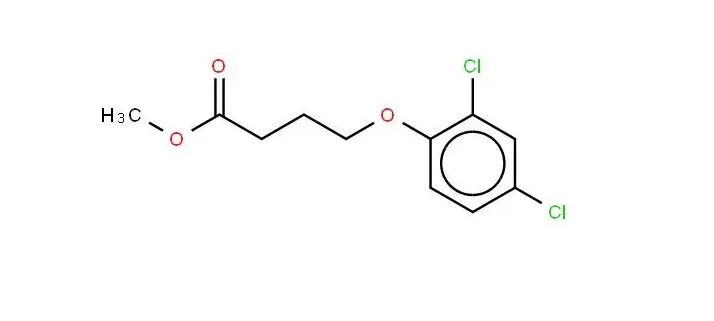
2,4-D butyric acid is an analogue of the hormone herbicide 2,4-D, and its mode of action is different from that of common hormone herbicides. It itself has no biological activity. After absorption, it is oxidized to 2,4-D by β-oxidase to act. In crops such as alfalfa, corn and rice, due to the low activity of β-oxidase, 2,4-D cannot be metabolized acid, showing a high degree of safety to these crops.
In the history of China, two imazethapyr products were temporarily registered to control annual weeds in alfalfa fields, but the two temporary pesticide registration certificates expired in 2008. The 200 g/L paraquat aqueous solution of Syngenta Ltd. of the United Kingdom was officially registered in China to control leguminous forage (including alfalfa) weeds, but it has been eliminated. In 1986, China approved the official registration of four 25% bentazone aqueous solution products that are still in effective state. The registered crops and control targets include broad-leaved weeds in grassland and pastures.
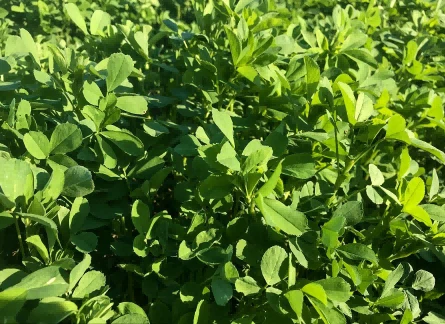
The test results of researchers from the Plant Protection College of Hebei Agricultural University and other units showed that among the 10 soil treatment herbicides tested, 33% pendimethalin EC and 48% trifluralin EC were effective against purple flowers at the recommended and doubled dosage levels. Alfalfa growth performance is safe. Among the 14 stem and leaf treatment herbicides tested, the recommended and doubled doses of 10% quizalofop-p-ethyl EC were safe for the growth of alfalfa, and 15% clodinafop-propargyl aqueous emulsion was safe for the growth of alfalfa at the recommended dose , but produced inhibitory effects at double doses.
The test results of researchers from the Institute of Plant Protection, Shandong Academy of Agricultural Sciences and other units show that memazazole can be used to control grasses or broad-leaved weeds in alfalfa fields, and has good safety and weed control effect on alfalfa; Methalofop, quizalofop-ethyl and clethodim can be used in alfalfa fields where grass weeds dominate; It has good control effect on broad-leaved weeds, but poor or ineffective control effect on grass weeds, so it can be applied to alfalfa fields dominated by broad-leaved weeds. The test results of researchers from the Institute of Plant Protection, Henan Academy of Agricultural Sciences and other units also showed that the dose of 86.4-100.8 g/hm2 of imazethapyr has better control effect on weeds, and has no adverse effects on the growth and quality of alfalfa and can significantly improve the growth and quality of alfalfa. It can increase the output and has good application value in production.
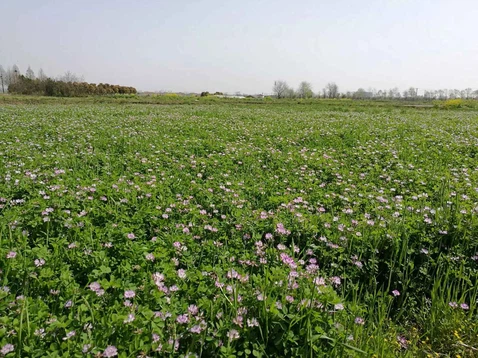
Alfalfa is an important pasture grass, mainly used in livestock feeding. Due to the high economic benefits of alfalfa, its production and sales have formed an industry. Alfalfa is prolific and high-quality, which can provide a steady stream of power for the sustainable development of China's animal husbandry. According to statistics, as of 2020, China's alfalfa planting area will reach 6.5 million mu, with an output of 3.4 million tons. However, domestic alfalfa currently accounts for only about 24% of the alfalfa consumption in farms, and the rest are imported alfalfa.
Source: Agropages